

 EN
EN
 PL
PL
 RU
RU

Non-obstructive azoospermia means sperm production is severely impaired. Obstructive azoospermia means sperm are being produced, but a blockage or missing duct prevents them from reaching the semen. A semen test may find no sperm in either condition, but treatment depends on why they are missing.
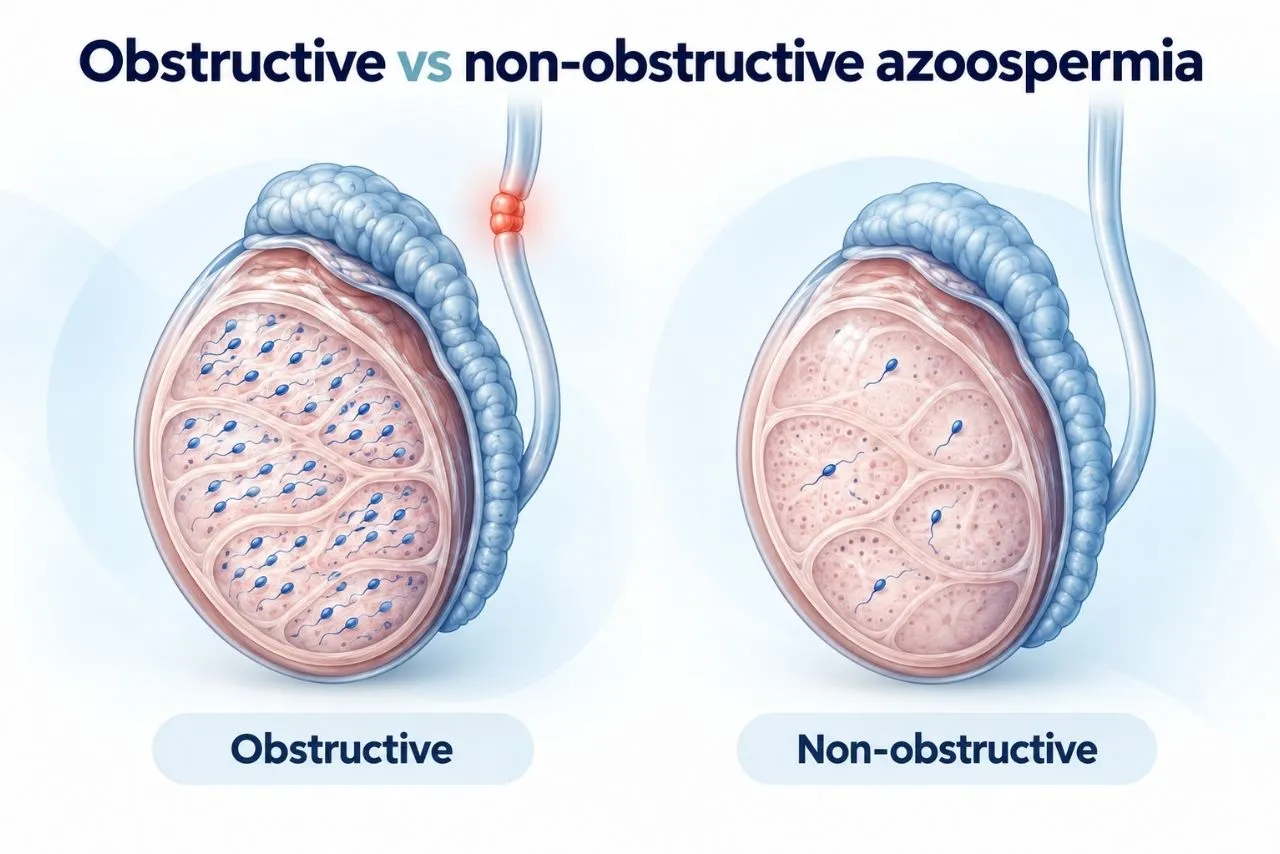
That distinction matters. An operation to repair a blocked tube cannot correct a sperm production problem, and hormone treatment cannot replace a duct that never developed.
If you are considering azoospermia assessment in Turkey, the first task is to establish why no sperm have been found—not to choose a treatment from the semen result alone.
Diagnosed with non-obstructive azoospermia?
Could the L-HIS method be an option for you? Contact Azoospermia Clinic Turkey to discuss your diagnosis, previous treatment and whether an assessment for L-HIS is appropriate for your case.
What is obstructive azoospermia?
Sperm develop in the testicles, then pass through the epididymis and vas deferens before entering the semen. In obstructive azoospermia (OA), an interruption along that route prevents sperm from appearing in the ejaculate.
Possible causes include:
- A previous vasectomy.
- Scarring after an infection or an operation.
- Congenital absence of the vas deferens—the tubes that carry sperm from the epididymides.
- A blockage affecting the ejaculatory ducts.
You may still ejaculate normally. Most seminal fluid comes from glands rather than the testicles, so semen can look normal even when it contains no sperm.
“Blocked sperm ducts” sounds like something that always needs unblocking. It does not. Whether reconstruction makes sense depends on the location and cause of the obstruction, your partner’s fertility and the alternatives available.
What is non-obstructive azoospermia?
In non-obstructive azoospermia (NOA), the main difficulty is making mature sperm rather than transporting them.
The underlying problem may involve the testicles themselves or the hormonal signals that support sperm production. Causes include certain genetic conditions, a history of undescended testicles, damage from chemotherapy and some hormonal disorders. Sometimes an investigation finds no clear cause.
NOA does not automatically mean that every part of each testicle has stopped producing sperm. Small areas of sperm production may remain, even when repeated semen samples contain none. The diagnosis alone cannot tell you whether a sperm retrieval procedure will succeed. [1]
Obstructive vs non-obstructive azoospermia at a glance
| Feature | Obstructive azoospermia | Non-obstructive azoospermia |
|---|---|---|
| Main problem | Sperm cannot reach the ejaculate because the pathway is blocked or absent | Sperm production is severely impaired |
| Sperm in the semen | None after appropriate laboratory examination | None after appropriate laboratory examination |
| Testicular size | Often within the usual range | May be reduced, but can be within the usual range |
| FSH result | Often within the laboratory reference range | Often raised in primary testicular dysfunction; may be normal or low in other situations |
| Treatment direction | Reconstructive surgery or sperm retrieval for ICSI | Cause-specific treatment where appropriate, or assessment for testicular sperm retrieval |
| What the diagnosis cannot promise | That repairing the pathway will result in pregnancy | That a retrieval procedure will find sperm |
These are clinical patterns, not a checklist for diagnosing yourself. A normal FSH result, for example, does not prove that you have an obstruction. [2]
How do doctors tell the difference?
Confirm the semen result
A single report needs follow-up. Doctors arrange a repeat semen analysis to confirm azoospermia and check that the laboratory has examined the sample appropriately, including the centrifuged deposit when indicated.
This also helps distinguish azoospermia from cryptozoospermia, where an extended search finds very rare sperm. The distinction can affect planning.
Read the findings together
A fertility assessment brings together your medical history, examination and blood results. Previous surgery, infections, cancer treatment, puberty and medication use can all provide useful clues.
The examination assesses the testicles and sperm-carrying structures. Hormone tests commonly include FSH, LH and testosterone; imaging may help when the findings suggest a particular anatomical problem.
No single result tells the whole story.
Use genetic testing where it can change care
Depending on the suspected cause, doctors may request a karyotype, Y-chromosome microdeletion testing or CFTR testing. CFTR testing is particularly relevant when the vas deferens is absent or unexplained obstruction is suspected.
These tests can influence treatment decisions and identify inherited risks. Genetic counselling helps you and your partner understand what a finding could mean before proceeding with fertility treatment. [3]
How do treatment options differ?
Non-obstructive azoospermia treatment
Treatment starts with the cause. A man whose pituitary gland is not providing adequate hormonal stimulation needs a different approach from someone with primary testicular damage.
For suitable men with NOA, micro-TESE offers a way to search the testicular tissue for areas that may contain sperm. The surgeon uses an operating microscope to guide tissue selection. If viable sperm are recovered, the fertility team may use them for ICSI or freeze them where appropriate. Finding sperm and achieving a pregnancy are separate outcomes. [1]
Hormonal treatment has an established role in hypogonadotrophic hypogonadism. It is not a routine solution for every man with NOA; NICE restricts several empirical hormone treatments for impaired semen parameters without this diagnosis to clinical trials. [4]
Planning an azoospermia assessment in Turkey
Before travelling from the UK for a consultation in Turkey, gather your semen analyses, hormone results and any genetic reports. Bring previous operation notes or testicular biopsy results if you have them, along with a list of medicines and supplements.
Ask three practical questions: what diagnosis do the findings support, what does the proposed treatment aim to achieve, and what happens if it does not work?
L-HIS method page describes the clinic’s approach for selected men with non-obstructive azoospermia. If you are discussing that protocol, ask the treating doctor about the evidence for your particular diagnosis, monitoring, adverse effects and alternative options. You can contact Azoospermia Clinic Turkey to discuss arranging an assessment. The purpose of that assessment is to clarify the diagnosis and realistic next steps.
Frequently asked questions
Usually not. Both types may cause no obvious symptoms beyond difficulty conceiving, and normal ejaculation does not rule out either condition.
No. High FSH can suggest impaired sperm production, but it cannot establish on its own that a retrieval procedure will find no sperm. [2]
Tablets cannot reconnect an absent vas deferens or remove an established scar blockage. Treatment depends on the anatomical cause.
The outlook depends on the cause. Some hormonal or medication-related problems may improve with appropriate care; other forms reflect lasting impairment. A diagnosis of NOA alone does not tell you which situation applies.
Yes, in some cases. The route may involve reconstruction, treatment of a specific hormonal disorder or sperm retrieval followed by ICSI. None guarantees a pregnancy or live birth.